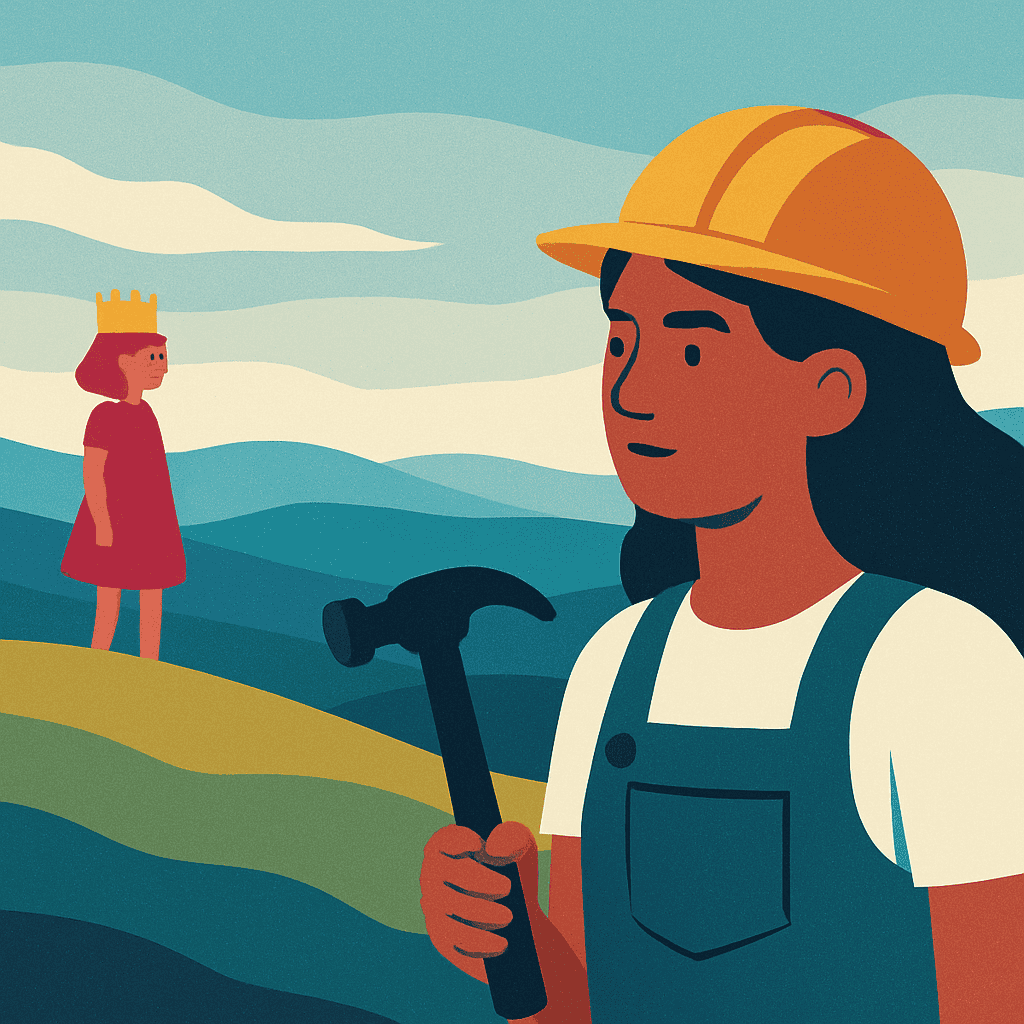
In Season 6 of What Does It Profit?, Dr. Dawn Carpenter goes inside industries where women are still underestimated and often unwelcome to explore how they are reshaping the meaning and structure of work.
In this episode, we meet Judaline Cassidy, a master plumber, union leader, and founder of Tools & Tiaras, a nonprofit that introduces girls to welding, carpentry, plumbing, and the power of the skilled trades.
Judaline was one of the only women in her plumbing program in Trinidad. She later broke barriers within New York’s unions. Along the way, she developed a simple conviction that guides her work today: Jobs do not have genders.
With every pipe she fits and every workshop she leads, Judaline is doing more than repairing infrastructure. She is challenging assumptions about who belongs in the trades and who gets to build the future.
Through Tools & Tiaras, she is creating pathways for girls to see technical skill as strength, economic independence as attainable, and the trades as dignified, essential work.
This episode explores what happens when women claim space in skilled labor and how expanding access strengthens the entire economy.
Because when more people are invited to build, we all benefit from what gets built.
Read Full Transcript
[00:00:08.930] - Speaker 1
Welcome to What Does It Profit?, the show where we bring you stories about the social and moral value of economic life.
[00:00:17.100] - Speaker 2
I'm Dr. Dawn Carpenter.
[00:00:18.770] - Speaker 1
Welcome back to Season 6. Over the next few episodes, we're grabbing our tool belt and a hard hat and heading to job sites where women workers are least expected. Women in the trades face a ton of challenges. Most of them stem from our society's deeply ingrained attitudes and expectations around gender roles.
[00:00:41.300] - Speaker 2
But there's good news.
[00:00:42.760] - Speaker 1
The overall situation for women in the skilled trades is getting better. Over the past 5 years, the number of women working in the skilled trades like plumbing, electrical, and construction increased by about 30%. That's according to the Institute for Women's Policy Research. And today, recruiting women workers is an opportunity that trade industries simply can't afford to ignore. The U.S. Chamber of Commerce has warned of an aging workforce that will bring a massive shortage of skilled workers. That means it's more important than ever to figure out what's keeping the trades from attracting and keeping women workers, and to do the hard work of making those industries more equitable. It's time for the kind of change that Judalyn Cassidy has spent her career building.
[00:01:46.960] - Speaker 3
All right, who is fearless? Amazing. Yo, you guys heard that? This is my crew, baby. This is my crew. All right, who is awesome? Amazing.
[00:02:06.370] - Speaker 4
They are nothing on us.
[00:02:07.730] - Speaker 3
And the last one, because people might say that we are not, but we know that we are. Who is strong?
[00:02:16.140] - Speaker 1
That's Judaline doing her signature call and response chant with campers at Tools and Tiaras, the nonprofit she helped to create to empower young women to enter the trades. Because as she always says, "Jobs don't have genders." It's more than a trademark catchphrase for Judaline.
[00:02:43.740] - Speaker 2
It's a lesson she's learned over a lifetime of breaking gender barriers.
[00:02:48.050] - Speaker 4
I grew up without a mother or father, and my great-grandmother was my custodian. Growing up, I was dreaming of absolutely being a lawyer and Wonder Woman because I love watching Wonder Woman and Bionic Woman, Nancy Drew, all the empowerment women. Like, I want to be that person, you know?
[00:03:09.390] - Speaker 2
When her great-grandmother passed away, Judaline couldn't afford to go to a university, so instead she attended a free trade school. She was among the first 3 women accepted into the plumbing program at John Donaldson Technical Institute in her native Trinidad, and Judaline was the only one of those 3 to actually graduate.
[00:03:32.030] - Speaker 4
I chose plumbing over electrical because I knew I could get wet and I didn't wanna get shocked.
[00:03:38.060] - Speaker 2
Can't argue with that. Going to a trade school to become a plumber was a life-changing opportunity for Judalyn. It was her chance to change her financial destiny.
[00:03:48.460] - Speaker 4
And once she started doing the job, I fell in love with it and I am still madly in love with plumbing.
[00:03:55.030] - Speaker 2
Judalyn moved to New York City in 1989. It was the first time she'd ever been on a plane.
[00:04:01.500] - Speaker 4
I was literally in shock. Like, from the airport, you land, it's so beautiful. You coming in on the water and JFK, seeing the statue and you seeing the World Trade Center at that time, you know, like, it's so beautiful. And you're like, oh my gosh, there's, you can make it there anywhere. And you like coming down and you go through customs and you go through all of that. You get in a taxi and you start driving. And New York was different back then. It's beautiful now, but You know, people coming in, but it was like, what the hell?
[00:04:31.790] - Speaker 2
The concrete jungle was a real shock to Judalyn, who'd grown up in Trinidad and Tobago, surrounded by trees and ocean air.
[00:04:40.220] - Speaker 4
Listen, I am a New Yorker at heart right now. Everywhere I go, people tend to say to me, you have an accent. And I think they're talking about my Trinidadian accent. It was like, no. So I am a New Yorker now, but I'm telling you, at first It was a culture shock.
[00:04:58.100] - Speaker 2
When she settled in Staten Island, her early jobs were as a housekeeper, nanny, and personal shopper. Jutaline thought she'd put away her tool belt for good until her next-door neighbor convinced her to take a local plumbing job.
[00:05:14.630] - Speaker 4
You remember that I told them I went to trade school and being a plumber in Trinidad. And my neighbor told them that he had a plumber, but he didn't tell them people that I was this 4-foot-11, cute-as-a-button girl plumber. Like, they wasn't expecting that. They was expecting some big broly, tall Black guy.
[00:05:36.150] - Speaker 2
This wasn't the comeback Judalyn expected.
[00:05:38.880] - Speaker 4
And this short little Black girl drove up in a Jeep looking all tall. When she came out, they was like, what the hell? And I showed up on the job and nobody was expecting this dynamite, this little package to open the door. That's how I got back into plumbing.
[00:05:57.760] - Speaker 2
And from that day on, she worked hard and became the first female plumber accepted into the Plumbers Local Union 371 in Staten Island. Later, she became the first woman elected to the examining board of New York City's Plumbers Local Union Number 1. Across her decades-long career, Judalyn has seen it all and thinks it's time that the plumbing industry undergoes serious rebranding.
[00:06:28.830] - Speaker 4
One time, one of those new shows had reached out to me and they asked me all of these cool questions about plumbing, and I was supposed to be on the show. And then last minute, the infamous words, we went in another direction. And they picked a guy who you would see is the typical plumber, a big, burly white dude. Nothing's wrong with him, awesome plumber. But what if you're saying you trying to hit a demographic, you reach out and then you still went with the guy, how are we changing the narrative?
[00:07:01.030] - Speaker 2
For Judalyn, the work is more than her skilled labor. She's made it her mission to change the narrative and bring other women along with her on the path she charted. In 2023, Judalyn was featured in a coloring book to celebrate women plumbers called "My Mom Is a Plumbing Superhero." The coloring book was created in collaboration with the International Association of Plumbing and Mechanical Officials.
[00:07:28.590] - Speaker 4
It talks about all the different facets of plumbing and make it relatable. Kid. And the other part that I did was let's include other women. So I have women from all different ethnicities in the book. So there's a woman who's wearing a hijab. There's a Spanish woman. I wanted when you pick up the book and give it to your son, he's like, wow, these are women. A girl picking it up and seeing a girl looking like her or somebody looking like her. She's like, oh, I can do that.
[00:07:57.080] - Speaker 2
You could argue that plumbing enables modern life as we know it. Anyone with a clogged toilet or an uncontrollable leak realizes that pretty quickly. But there's more to plumbing than meets the eye.
[00:08:09.610] - Speaker 4
People see the faucet and stuff like that, but behind that wall is magic. It's Picasso. It's beautiful. Well, if you have a great plumber that likes to do neat work, it's beautiful.
[00:08:28.600] - Speaker 5
What Does It Profit? is a production of the Solidarity Economy Workshop at Georgetown University. The show is hosted by me, Dr. Dawn Carpenter. Jordan Gaspereau is our senior producer. Phoebe Lett produced this episode with production assistance from Alexis Harper. Our engineer and designer is Mark Busch. Thanks to our Season 6 intern, Abby Trepas. Original music for What Does It Profit? was composed by Nick Pennington. Additional music provided by Epidemic Sound. Tools and Tiaras audio provided by MRW Productions. Support for What Does It Profit? is provided by the Kalmanovitz Initiative for Labor and the Working Poor and the Capital Applied Learning Lab at Georgetown University. You can learn more at whatdoesitprofitpodcast.com.
More Episodes
S6.E8 | Burying the Doubt: Women Rebuild Death Work
For most of human history, women cared for the dead. They prepared bodies and guided families through grief. Then death became a business, and women were pushed out. In this episode of What Does It Profit?, Dr. Dawn Carpenter brings…
S6.E7 | Beyond Play: The Business of Belonging
In this episode of What Does It Profit?, Dr. Dawn Carpenter explores what happens when a business begins with a simple question. Where do people go to belong? More women are starting businesses than ever before. Yet ownership does…

S6.E6 | Game Changer: Rewriting the Rules
A board game may look simple. A set of pieces. A set of rules. A way to win. But every game is a system. It teaches us what to value, how to compete, and what success looks like. In this…